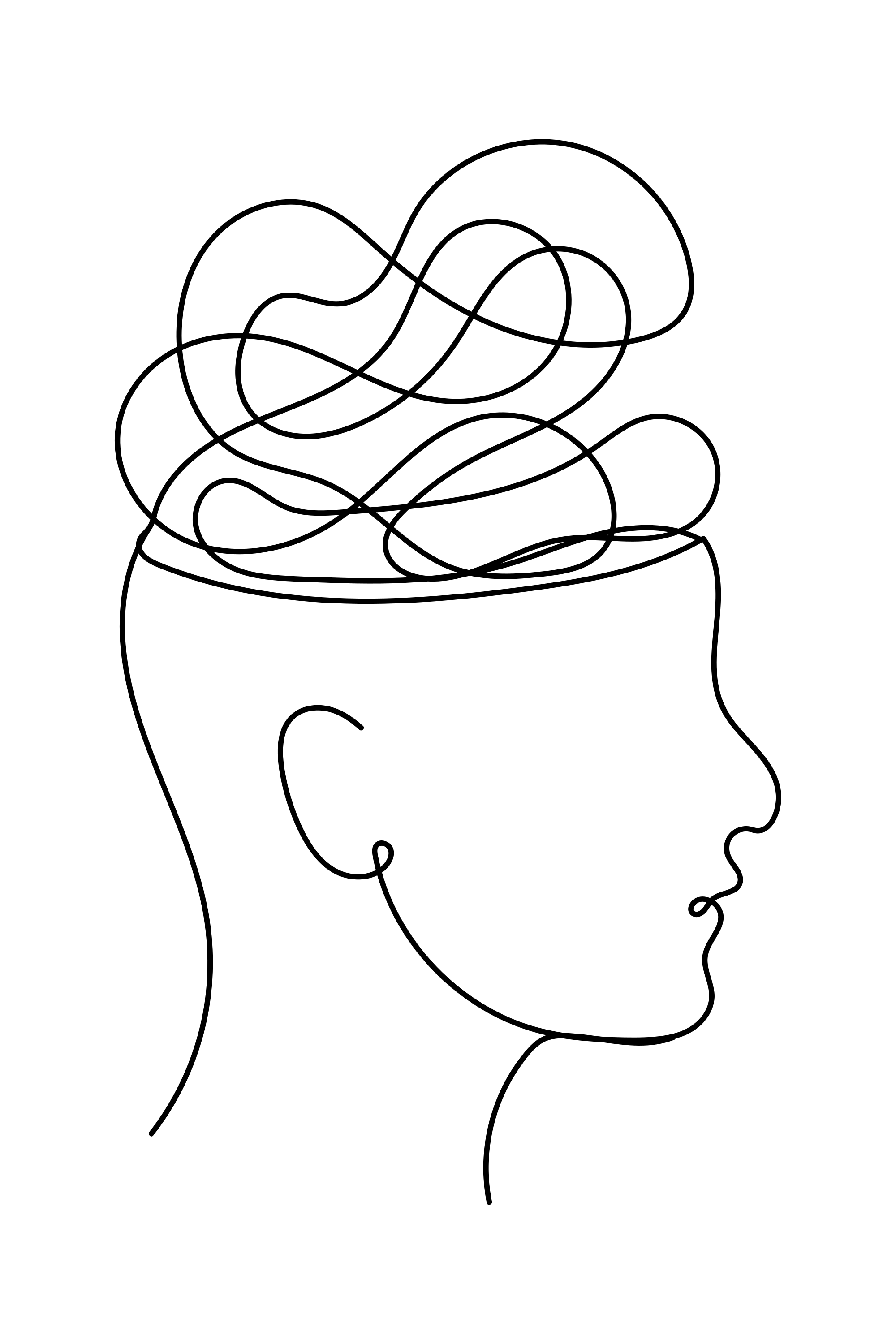
If you've ever stood in front of a mirror, told yourself "I am worthy of love and success," and immediately felt like a fraud — you're in very good company. The whole concept of affirmations can seem painfully close to wishful thinking. Repeating nice words to yourself? That's supposed to change anything?
It's a fair question. And you deserve a real answer — not vague promises, but the actual evidence. So let's look at what more than thirty years of psychology and neuroscience research has to say about whether affirmations work, how they work, why they sometimes don't, and how to use them in a way that genuinely helps.
Where affirmations come from: self-affirmation theory
Affirmations didn't start as an Instagram trend. The scientific foundation was laid in 1988 by social psychologist Claude Steele, who proposed self-affirmation theory. His core insight was that people are fundamentally motivated to see themselves as good, competent, and morally adequate. When something threatens that self-image — a harsh critique, a failure, a moment of deep uncertainty — it creates real psychological distress.
Steele's theory proposed something counterintuitive: you don't have to directly fight the specific threat to feel better. Instead, you can affirm a different part of your identity that matters to you. If you bombed a presentation at work, you don't necessarily need to convince yourself you're a great presenter. You might remind yourself that you're a devoted parent, a loyal friend, or someone who values creativity. That broader sense of self-worth acts as a psychological buffer.
This distinction is important because it separates self-affirmation from the caricature of standing in a mirror chanting "I'm amazing." The research is about reconnecting with your core values and the parts of yourself that feel solid — not about manufacturing confidence from thin air.
What happens in your brain when you affirm yourself
For a long time, the evidence for affirmations was purely behavioral — researchers could see that people acted differently after affirming exercises, but nobody could explain the mechanism inside the brain. That changed with neuroimaging.
A landmark 2016 study published in Social Cognitive and Affective Neuroscience[1] put participants in an fMRI scanner and asked them to reflect on their core personal values. The results were striking. Self-affirmation activated two key brain regions: the ventromedial prefrontal cortex (vmPFC) and the ventral striatum. The vmPFC is central to how you think about yourself — it's the brain region that processes self-relevant information, weighing what matters to you and how you see your place in the world. The ventral striatum is part of the brain's reward system, the same circuitry that lights up when you eat something delicious, receive a compliment, or achieve a goal you've been working toward.
What this means in practical terms: when you affirm something that genuinely connects to your values, your brain responds as though something good has actually happened to you. It's not pretending. The neural signature is real.
The same study found something even more interesting. The degree of vmPFC activation during affirmation predicted whether participants would actually change their behavior in the following week — specifically, whether they became more physically active in response to health messaging. The brain activity wasn't just a feel-good blip. It was forecasting real-world change.
The neuroplasticity connection
The longer-term mechanism behind affirmations is neuroplasticity — your brain's lifelong ability to rewire itself based on repeated experience. Every thought you think repeatedly strengthens the neural pathway associated with it. This is the same principle that allows you to learn a language, develop a tennis serve, or memorize a song. Repetition builds the road.
When it comes to your inner dialogue, this cuts both ways. If you've spent years telling yourself "I always mess things up," that neural pathway is well-paved. The thought comes easily, almost automatically, because your brain has practiced it thousands of times. Affirmations work by building an alternative pathway. At first, the new thought — "I'm capable of handling challenges" — feels bumpy and unfamiliar. But with consistent repetition, that pathway strengthens while the old one gradually weakens from disuse.
This isn't overnight transformation. It's the same patient process as building any skill. But understanding this takes affirmations out of the realm of magic and into the realm of brain training.
What the research says affirmations can do
Let's get specific. Across hundreds of studies, self-affirmation has been linked to several measurable outcomes.
Reduce your stress response
A 2013 study published in PLOS ONE[2] found that participants who completed a brief self-affirmation exercise before a stressful task showed significantly lower cortisol levels than those who didn't. Cortisol is your body's primary stress hormone — the chemical messenger behind racing thoughts, tight shoulders, and that overwhelming feeling of dread before something difficult.
Think about what this means practically. Before a job interview, a difficult conversation, or a medical appointment, spending a few minutes reflecting on your core values can measurably lower your physiological stress. You're not eliminating the challenge, but you're meeting it with a calmer nervous system.
Improve performance under pressure
That same research by Creswell and colleagues[2] demonstrated that self-affirmation improved problem-solving performance during high-stress conditions. Participants who affirmed their values before a pressured task performed better than those who didn't — not because they became smarter, but because the affirmation reduced the anxiety that was getting in their way.
This is a crucial nuance. Affirmations don't give you abilities you don't have. They help clear the mental static that prevents you from accessing abilities you already possess. If you've ever frozen during a test you studied for, or gone blank during a presentation you rehearsed, you know exactly what that static feels like.
Make you more open to feedback
One of the most consistent findings in the research is that self-affirmation reduces defensiveness. A 2006 study by Sherman and colleagues[3] found that participants who affirmed their values were significantly more willing to accept threatening health information and change their behavior accordingly.
Without affirmation, the brain tends to shoot the messenger. You get a warning about your health, your spending, or your relationship patterns, and your first instinct is to dismiss it, rationalize it, or get angry at the person delivering it. Affirmation softens that defense by reminding you that your overall self-worth isn't riding on this one piece of feedback. You can absorb the difficult information because your identity isn't on the line.
Reduce achievement gaps
Some of the most powerful affirmation research comes from education. A series of studies by Cohen, Garcia, and colleagues[4] found that brief values-affirmation exercises dramatically reduced racial achievement gaps in schools. Students who spent fifteen minutes writing about their most important values at the start of a semester earned significantly higher grades than control groups — and the effects lasted for years.
The mechanism here is about threat. Students who belong to negatively stereotyped groups carry an extra cognitive burden — the worry that they might confirm a negative stereotype. This worry consumes mental resources that could otherwise go toward learning. Affirmation relieves some of that burden by grounding students in a broader sense of identity and worth.
Support healthier habits
Multiple studies have linked self-affirmation to improved health behaviors. People who affirm their values respond less defensively to health warnings and are more likely to increase physical activity, eat more fruits and vegetables, reduce alcohol consumption, and use sunscreen more consistently. A meta-analysis by Epton and colleagues[5] synthesized data from multiple self-affirmation and health-behavior studies, confirming that self-affirmation interventions produce small but reliable improvements in behavioral intentions and actual health behaviors.
The pattern across all of these findings is consistent: affirmation doesn't change external reality. It changes your internal relationship to reality, which then changes how you respond to it.
When affirmations backfire (and why)
Here's where honesty matters. Affirmations don't work for everyone in every situation, and pretending otherwise would be doing you a disservice.
The most important caveat comes from research on self-esteem. A widely cited 2009 study by Wood, Perunovic, and Lee found that people with low self-esteem actually felt worse after repeating the statement "I am a lovable person." The affirmation was so far from their self-concept that it triggered a contrast effect — the gap between the statement and their felt reality became more painful, not less.
This doesn't mean affirmations are useless for people struggling with self-worth. It means the wrong affirmation is worse than no affirmation. Telling yourself "I am the most confident person in the room" when you feel terrified isn't brave — it's a setup for your brain to argue back with every piece of evidence to the contrary.
The believability threshold
Effective affirmations need to land in what you might call the stretch zone — statements that push beyond your current self-image but don't snap the thread of believability. There's a meaningful difference between these:
- Too far: "I am fearless and unstoppable." (If you don't feel this, your brain will reject it immediately.)
- Too safe: "I exist." (True, but it's not doing any psychological work.)
- The stretch zone: "I am learning to trust myself in difficult moments." (Acknowledges where you are. Points toward where you want to be. Your brain can accept it.)
The most effective affirmations are ones that feel slightly uncomfortable but not dishonest. You should feel a gentle pull forward, not the whiplash of claiming something your entire nervous system knows isn't true.
Affirmations aren't a replacement for action
Another way affirmations can go sideways is when they substitute for doing the actual work. If you're affirming "I am financially abundant" while ignoring your credit card statements, the affirmation becomes a way of avoiding reality rather than engaging with it. The research is clear that affirmations work best when paired with action. They're the mindset shift that makes the action possible — not a replacement for it.
Think of affirmations as loosening a tight lid on a jar. The affirmation doesn't open the jar for you, but it makes your grip strong enough that you actually can.
How to practice affirmations effectively
Based on the full body of research, here's what actually makes affirmation practice work.
Root them in your real values
The most effective affirmations aren't generic positive statements — they're connected to what genuinely matters to you. In the research, participants don't typically repeat pre-written phrases. They write about their own core values: family, creativity, humor, justice, learning, kindness. Your affirmation practice should draw from the same well.
Ask yourself: What kind of person do I want to be? What matters to me most, independent of anyone else's opinion? Those answers are the raw material for affirmations that actually resonate.
Use present tense, but stay honest
Frame affirmations as present-tense realities or active processes, not distant future hopes. "I will be confident someday" places confidence on the horizon where it always stays out of reach. "I am building my confidence" puts you in the driver's seat right now.
Some formats that work well:
- "I am someone who values ___." (Values-based, almost always true.)
- "I am learning to ___." (Process-oriented, inherently believable.)
- "I choose to ___ today." (Action-oriented, grounded in the present.)
- "I am allowed to ___." (Permission-giving, especially powerful for people-pleasers.)
- "Even when ___, I can ___." (Acknowledges difficulty, doesn't pretend it away.)
Be consistent, not intense
The neural rewiring effect depends on repetition over time, not occasional bursts of enthusiasm. Five minutes every morning builds stronger pathways than an hour-long session once a month. Your brain doesn't need volume — it needs frequency.
This is one of the most liberating things about affirmation practice: it doesn't require heroic effort. It requires showing up briefly and regularly. A few affirmations during your morning coffee, a moment of reflection before bed, a quiet pause in the car before walking into work. Small and steady wins the neuroplasticity game.
Pair words with feeling
Affirmations that stay purely cognitive — words recited on autopilot — are less effective than affirmations that engage your emotional system. When you say "I am worthy of care and rest," pause long enough to actually feel what that would mean. Let the words land in your body, not just your head.
This doesn't require dramatic emotion. Even a slight softening in your chest, a small release of tension in your jaw, a moment of warmth — that's the affirmation doing its work. You're teaching your nervous system, not just your intellect.
Combine with aligned behavior
Affirmations gain power when you back them up with even small, congruent actions. If your affirmation is "I prioritize my well-being," follow it with one act of self-care that day — drink an extra glass of water, take a ten-minute walk, say no to something that drains you. The action gives the affirmation evidence, and the affirmation gives the action meaning. They reinforce each other.
Affirmations and mental health: important boundaries
This needs to be said clearly: affirmations are a wellness tool, not a clinical treatment. If you're experiencing depression, anxiety disorders, PTSD, or other mental health conditions, affirmations might be a helpful complement to professional care, but they are not a substitute for therapy or medication.
In fact, for some mental health conditions, certain types of affirmations can be counterproductive without professional guidance. Someone in a deep depressive episode may find that positive affirmations increase feelings of shame or inadequacy, because the gap between the affirmation and their emotional reality feels insurmountable. A therapist can help you find the right starting point and tailor affirmation work to your specific needs.
Think of it this way: if affirmations are a daily vitamin, therapy is surgery when you need it. Both are valuable. Neither replaces the other.
What makes affirmations different from "positive thinking"
People often conflate affirmations with the broader positive-thinking movement, and this is where a lot of the justified skepticism comes from. The "just think positive" approach can veer into toxic positivity — denying real problems, suppressing valid emotions, and blaming people for their own suffering because they "weren't positive enough."
Research-backed affirmation practice is fundamentally different. It doesn't ask you to pretend everything is fine. It doesn't deny your struggles. It says: you are more than your current struggle. Your identity is larger than this one problem. You have values and strengths that remain intact even when life is hard.
The distinction is between denial and perspective. Positive thinking says "There's no problem." Self-affirmation says "There's a problem, and I'm still a whole person who can deal with it."
That difference matters enormously. One shuts down honest engagement with difficulty. The other makes honest engagement possible by giving you a secure psychological foundation to stand on while you face it.
The bottom line
Affirmations aren't magic. They're not a shortcut around hard work, and they won't transform your life overnight. But they are a well-studied psychological tool backed by three decades of research and validated by brain imaging. When practiced consistently, rooted in your real values, and calibrated to where you actually are right now, they can measurably reduce stress, improve your performance under pressure, open you to growth, and gradually reshape the way you relate to yourself.
The best affirmation isn't the most impressive one. It's the one that meets you exactly where you are, feels just barely beyond your comfort zone, and gently reminds you of something true about who you are. That's where change begins — not in grand declarations, but in quiet, honest moments of reconnection with yourself.
Frequently asked questions
How long do I need to practice affirmations before I notice a difference?
Most people begin noticing subtle shifts within two to four weeks of consistent daily practice. You might realize you're slightly less rattled by criticism, or that a negative thought doesn't spiral as far as it used to. The neuroscience suggests that meaningful neural pathway changes take consistent repetition over weeks, not days. But "noticing a difference" and "complete transformation" are very different things — the early changes are quiet, and that's okay. The key variable isn't time, it's consistency. Five minutes daily for a month will do more than an hour once a week.
Can affirmations help with anxiety?
The research on stress reduction is encouraging — self-affirmation has been shown to lower cortisol and improve performance under pressure, which directly intersects with anxious experience. For everyday worry and nervousness, affirmations can be a genuinely useful grounding tool. However, for clinical anxiety disorders — persistent, overwhelming anxiety that interferes with daily life — affirmations should be part of a broader approach that includes professional support. They can complement therapy beautifully, but they're not a standalone treatment for anxiety disorders.
What if affirmations feel fake or cringey?
This is extremely common, and it doesn't mean affirmations won't work for you — it usually means you haven't found the right ones yet. If "I am a radiant being of light" makes you cringe, that's good judgment, not resistance. Try affirmations that sound like something you'd actually say. "I'm doing my best, and that's enough for today" or "I'm allowed to take up space" might feel much more authentic. You can also start with values-based affirmations — simply reflecting on what matters to you — rather than identity statements. The format is less important than the emotional truth behind it.
Do I need to say affirmations out loud?
Not necessarily. The research has used a variety of methods — writing, silent reflection, verbal repetition — and all have shown benefits. That said, some people find that saying affirmations out loud or writing them by hand makes the practice feel more real and intentional. It engages more of your senses and can help you stay focused rather than rushing through the words on autopilot. Experiment with what feels most natural. The method that you'll actually do consistently is better than the theoretically "optimal" one you avoid.
Sources
- Cascio, C. N. et al. (2016). "Self-affirmation activates brain systems associated with self-related processing and reward." Social Cognitive and Affective Neuroscience, 11(4), 621-629. Link
- Creswell, J. D. et al. (2013). "Self-affirmation improves problem-solving under stress." PLOS ONE, 8(5), e62593. Link
- Sherman, D. K. et al. (2006). "The psychology of self-defense: Self-affirmation theory." Advances in Experimental Social Psychology, 38, 183-242.
- Cohen, G. L., Garcia, J., Apfel, N., & Master, A. (2006). "Reducing the racial achievement gap: A social-psychological intervention." Science, 313(5791), 1307-1310. Link
- Epton, T., Harris, P. R., Kane, R., van Koningsbruggen, G. M., & Sheeran, P. (2015). "The impact of self-affirmation on health-behavior change: A meta-analysis." Health Psychology, 34(3), 187-196. Link
Start your affirmation practice
Lina delivers personalized affirmations to your day across 14 categories. Try it free for 3 days.