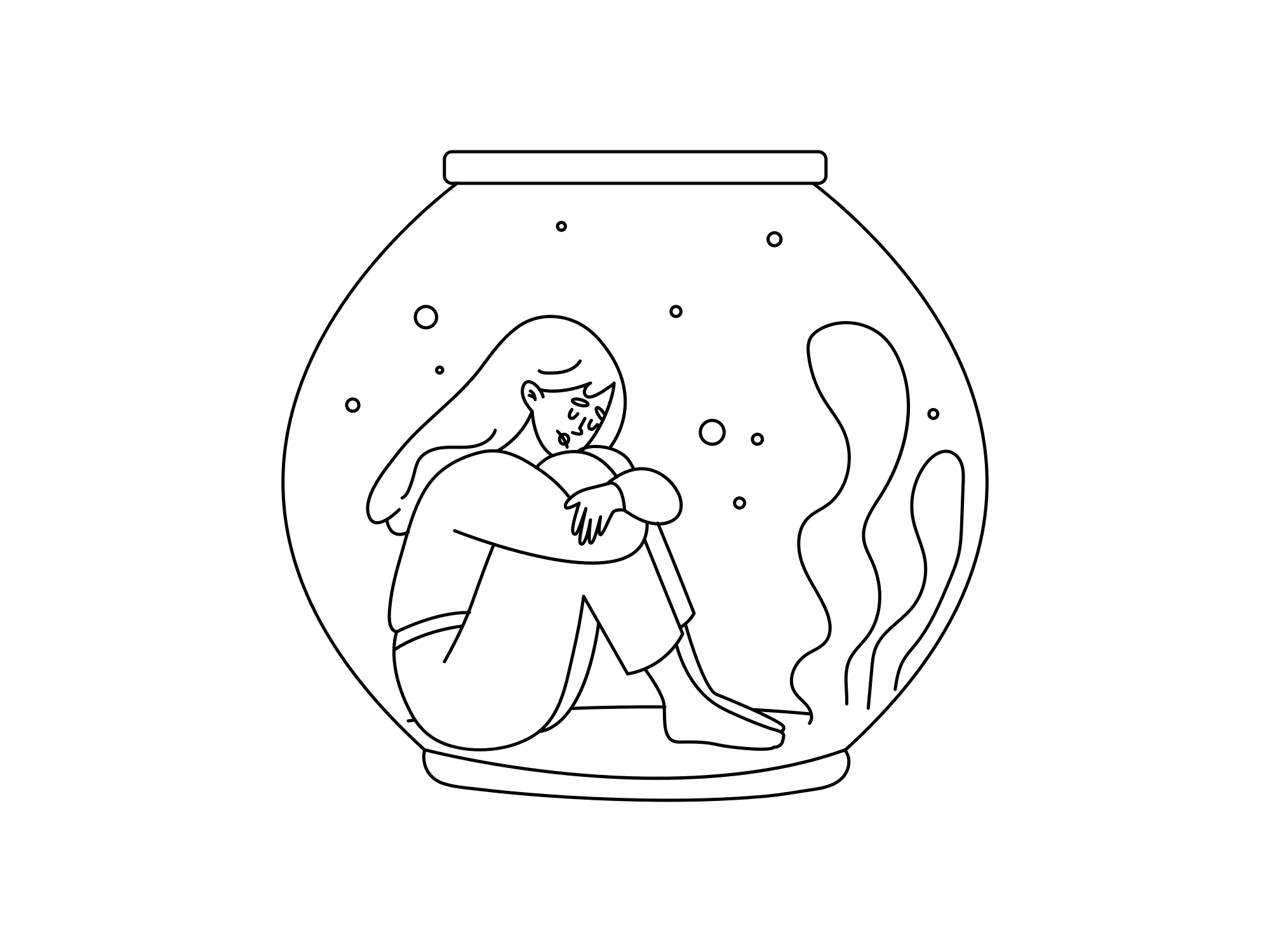
If you're an introvert, you've heard the advice. "You just need to put yourself out there!" "Have you tried being more outgoing?" "You'd have so much fun if you came to the party!" This advice is always delivered with the best of intentions and the complete confidence of someone who has never felt their soul leaving their body during forced small talk at a networking event.
Here's what the advice-givers don't always understand: introversion isn't shyness. It isn't social anxiety. It isn't a problem that needs solving. It's a fundamental difference in how your brain processes stimulation. Introverts aren't broken extroverts. They're people whose nervous systems are wired to recharge through solitude rather than socializing. That's it. That's the whole thing.
And yet, we live in a world that is built, rather aggressively, for extroverts. Open-plan offices. Team-building retreats. The unspoken assumption that wanting to be alone is somehow suspicious. It's exhausting, and not just physically. The constant pressure to perform extroversion takes a toll on how introverts see themselves. After enough years of being told your natural way of being is wrong, it's hard not to start believing it.
That's where these affirmations come in. Not to make you louder or more outgoing, but to remind you that quiet has its own kind of strength.
Honoring your nature
Before we get to the social stuff, let's start with something more fundamental: the way you exist in the world is not a deficiency. You don't need to apologize for needing alone time any more than someone needs to apologize for needing lunch. It's not a preference. It's how you function.
- "My need for solitude is not selfishness. It's self-awareness." Knowing what you need to function well and honoring that need is one of the most mature things a person can do. The fact that what you need happens to be quiet doesn't make it less valid.
- "I don't have to fill every silence." Silence isn't awkward. It's only awkward if someone has decided it is, and you don't have to agree with them. Some of the best moments happen in the spaces between words.
- "The way I recharge is just as valid as anyone else's." Your extroverted friends recharge at dinner parties. You recharge with a book and a closed door. Neither approach is better. They're just different operating systems.
- "My inner world is rich, and that richness matters." Introverts tend to have deep, complex interior lives. The thinking, the observing, the processing that happens in solitude isn't empty time. It's where some of your best ideas, insights, and connections take shape.
- "I am whole, exactly as I am." You are not an extrovert with a missing piece. You are a complete person whose completeness just happens to look a little quieter than what the world expects.
Navigating social demands
Let's be honest: the world requires socializing. Jobs require meetings. Relationships require conversations. Life requires occasionally leaving the house, even when the house is very cozy and the outside world is very loud. These affirmations aren't about avoiding social situations altogether. They're about navigating them without losing yourself in the process.
- "I can show up without performing." You don't have to be the life of the party. You can attend the party, have two meaningful conversations, and leave when your battery hits 20%. That's a successful outing.
- "Setting boundaries is a gift I give to myself and others." When you say no to the third social event this week, you're not being difficult. You're making sure that when you do show up, you can actually be present. The people who matter will understand this.
- "I choose depth over breadth, and that's a strength." You might not work the room, but you'll have a conversation that someone remembers for weeks. Introverts tend to build fewer but deeper relationships, and those connections are powerful.
- "I can leave when I need to." This is permission you might not know you need. You can leave the party early. You can step outside for air. You can excuse yourself from the group conversation. You don't need an excuse. "I'm ready to go" is a complete sentence.
- "My quiet presence has value." Not every contribution needs to be loud. Listening deeply, thinking before speaking, noticing what others miss: these are contributions too. Meetings, friendships, and teams are better because you're in them, even when you're the quietest person in the room.
Recharging without guilt
Here's where the guilt usually lives. You've been invited to something. You don't want to go. You know you'd have a better evening at home. But the voice in your head says, "You should go. Normal people go. What's wrong with you?" Nothing. Nothing is wrong with you. The battery metaphor exists for a reason, and nobody expects a phone to run all day without plugging in.
- "Rest is not laziness. It's how I restore myself." When you cancel plans to stay home, you're not being lazy. You're doing essential maintenance. You wouldn't call someone lazy for charging their laptop.
- "I don't owe anyone my energy." Your energy is a limited resource, and you get to choose where it goes. If someone is offended that you need time alone, that says more about their expectations than your character.
- "I can enjoy my own company." There's a difference between loneliness and solitude, and introverts know this instinctively. Enjoying time alone isn't sad. It's one of the most underrated life skills there is.
- "Tomorrow, I'll have more to give." The beautiful thing about recharging is that it works. The quiet evening you spend reading or cooking or doing absolutely nothing means that tomorrow, you'll show up to the people and projects that matter to you with more focus, more patience, and more genuine warmth than you could have mustered on an empty tank.
- "My pace is my own." You don't have to match anyone else's social calendar, energy level, or enthusiasm. You're allowed to move through life at the speed that actually works for you, even if that speed is slower and quieter than what the world seems to demand.
A quiet revolution
The world is slowly getting better at understanding introversion, but slowly is the key word. In the meantime, you might still encounter the well-meaning friend who insists you'd love karaoke, the manager who equates visibility with value, or the family member who worries that you're "too quiet."
When those moments come, you don't need to launch into a defense of your personality type. You don't need to explain the neuroscience of dopamine sensitivity or cite research on introvert leadership. You just need to know, somewhere steady and sure inside yourself, that the way you move through the world is not a weakness. It's your way. And it's a good one.
The loudest voice in the room isn't always the wisest. Sometimes the person who changes everything is the one sitting quietly in the corner, thinking deeply, noticing what everyone else missed, and waiting for the right moment to speak. Sometimes that person is you.
Start your affirmation practice
Lina's Confidence and Mindfulness categories are perfect for introverts who want grounding, not performing. Quiet affirmations for quiet strength. Try it free for 3 days.